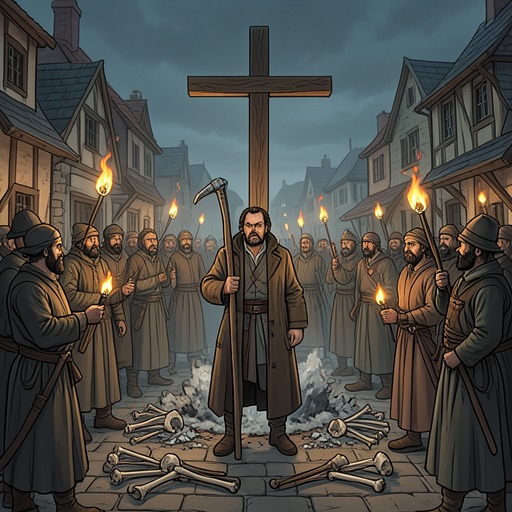
Johann Flückinger
A History of the Vampire in Popular CultureJohann Flückinger occupies a crucial position between folklore, medical observation, military authority, and the later literary history of the vampire. Sent to investigate supposed vampire attacks in a Serbian village in 1731, he examined exhumed bodies that local residents believed were feeding upon the living. His report did not simply record a superstition: once mentioned in The London Journal in 1732, it became the first known reference to vampires in the English press and helped turn a local crisis into portable cultural evidence.
Investigation in Serbia
In the early eighteenth century, eastern Europe experienced a series of alleged vampire sightings that encouraged communities to hunt, exhume, and stake suspected undead bodies. This eighteenth-century vampire craze emerged in a world where sudden deaths were difficult to explain and where religious, communal, and medical interpretations competed for authority. In one Serbian village in 1731, thirteen people died in sufficiently rapid succession to alarm the population. A doctor specialising in infectious diseases was sent to determine the cause, but his conclusion that malnutrition was probably responsible failed to satisfy residents who attributed the deaths to vampire attacks.
The villagers persuaded the doctor to exhume the suspected corpses. The bodies appeared to have undergone little decomposition, and their mouths seemed to contain what the doctor interpreted as fresh blood. These observations were treated locally as confirmation that the dead had been returning to drain the life of their surviving neighbours. The case therefore became more than a sequence of deaths: it became a dispute over which signs counted as evidence and which authority had the right to interpret a corpse.
Military and Official Authority
Officials in Vienna did not accept the initial findings without further scrutiny. They sent Johann Flückinger, a respected military surgeon, to examine the case, accompanied by other doctors and army officers who could serve as witnesses. His assignment placed the investigation within an expanding network of imperial administration, military expertise, and documentary verification. The presence of several observers suggests that the supposed vampire epidemic was considered serious enough to require an authoritative account rather than merely a local ritual response.
Flückinger and his companions found that many of the bodies showed no major decomposition. They also agreed that the corpses had taken on a plump appearance. Such physical changes could be interpreted by frightened observers as proof that the dead had consumed blood, even though postmortem processes could produce appearances that seemed startlingly alive. The investigation thus preserved the tension at the heart of vampire testimony: the officials inspected material bodies, but the meaning assigned to those bodies remained entangled with communal fear and inherited belief.
Report and Cultural Afterlife
Flückinger’s investigation was recorded in a report that entered wider circulation when it was mentioned in The London Journal in 1732. That publication made the episode the first known reference to vampires in the English press. The report’s importance therefore lies not only in what Flückinger saw in the Serbian village, but also in how his findings travelled. A local accusation, filtered through medical and military documentation, became a printed account available to readers far beyond the original site of fear.
The case also helped supply later writers with the appearance of historical verification. Antoine Augustin Calmet, a Benedictine monk and renowned academic from Lorraine, discussed reports of revenants and vampires in The Phantom World, first published in 1746 and revised and extended in 1751. Calmet quoted material from Lettres Juives describing a scene of vampirism in Hungary attested by officers of the tribunal of Belgrade and an officer of the emperor’s troops at Graditz. Within this wider documentary culture, investigations such as Flückinger’s could be read both as records of superstition and as apparently serious testimony about the undead.
From Case Record to Vampire Tradition
Flückinger’s inquiry belongs to a historical moment when scientific knowledge, spiritualism, religious belief, and public credulity could coexist uneasily. The nineteenth century would later be described as an age of rapid technological change and industrial development in which newspapers could still report witchcraft as fact. Earlier vampire reports likewise reveal how communities used supernatural explanations to give shape to mortality that otherwise seemed arbitrary. When tuberculosis spread through households in New England, for example, families sometimes imagined that the dead were stealing the life force of survivors; in the Mercy Brown case, medical objections were overridden by the demand for a supernatural remedy.
The Serbian investigation consequently stands at an important threshold. It belongs to a period when corpses were inspected for signs of vampirism, yet it also demonstrates the growing power of formal reports, professional witnesses, and print circulation. Later literary figures developed the vampire into increasingly recognisable forms: Varney introduced sharpened, fang-like teeth and became a conflicted, partly sympathetic character; Carmilla established the elegant nocturnal predator; and Count Dracula became a fully rounded figure with plans, personality, and moral agency. Flückinger did not create those fictional conventions, but the documentary tradition surrounding his investigation helped make the vampire appear to possess a history that literature could repeatedly reinvent.
Historical Significance
Johann Flückinger is significant because his name marks a transition from village panic to institutional narrative. The Serbian residents supplied the fear, the corpses supplied ambiguous physical signs, and imperial authorities supplied the demand for examination and testimony. Flückinger’s report then carried the episode into the English press, where it could participate in the long formation of vampire mythology.
His investigation also illustrates how supernatural history is produced. Medical explanations did not automatically displace folk belief; instead, doctors, military officers, officials, reporters, and later scholars each added a layer of interpretation. The result was neither a simple confirmation of vampirism nor a clean victory of science over superstition. It was a durable record of uncertainty, shaped by death, communal anxiety, institutional power, and the persuasive force of a documented body.